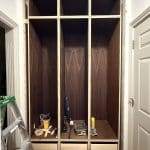
During our recent mudroom locker build, I had to visit two different lumberyards to find the right walnut boards because not all lumber is cut the same way. Most of the project called for plain-sawn walnut, but for the extra-tall locker door stiles (71 inches!), I specifically tracked down quarter-sawn lumber. That search was a perfect reminder: the way a log is milled—plain-sawn, quarter-sawn, or rift-sawn—has a huge impact on a board’s stability, grain pattern, and resistance to warping, twisting, bowing, or cupping. In this post, I’ll break down the differences between these lumber cuts and show you how choosing the right one can help you avoid common woodworking headaches.
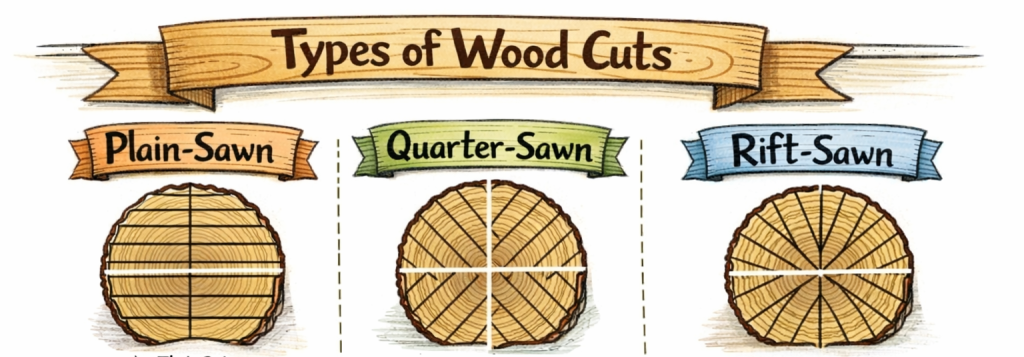
The Importance of Lumber Cuts: Plain Sawn vs Quarter Sawn vs Rift Sawn
Wood movement is a fact of life for every woodworker. Wood is a dynamic, natural material that constantly responds to its environment. As humidity rises and falls throughout the year, wood expands and contracts across the grain. The way a board is cut from the log determines how much movement occurs and in what direction. The orientation of the growth rings inside the board affects:
- dimensional stability
- likelihood of cupping, bowing, or twisting
- grain patterns
- cost and availability
This is where the terms plain-sawn, quarter-sawn, and rift-sawn come in. They simply describe how the log was sliced into boards, which in turn affects stability, appearance, and overall performance.
Plain Sawn Lumber
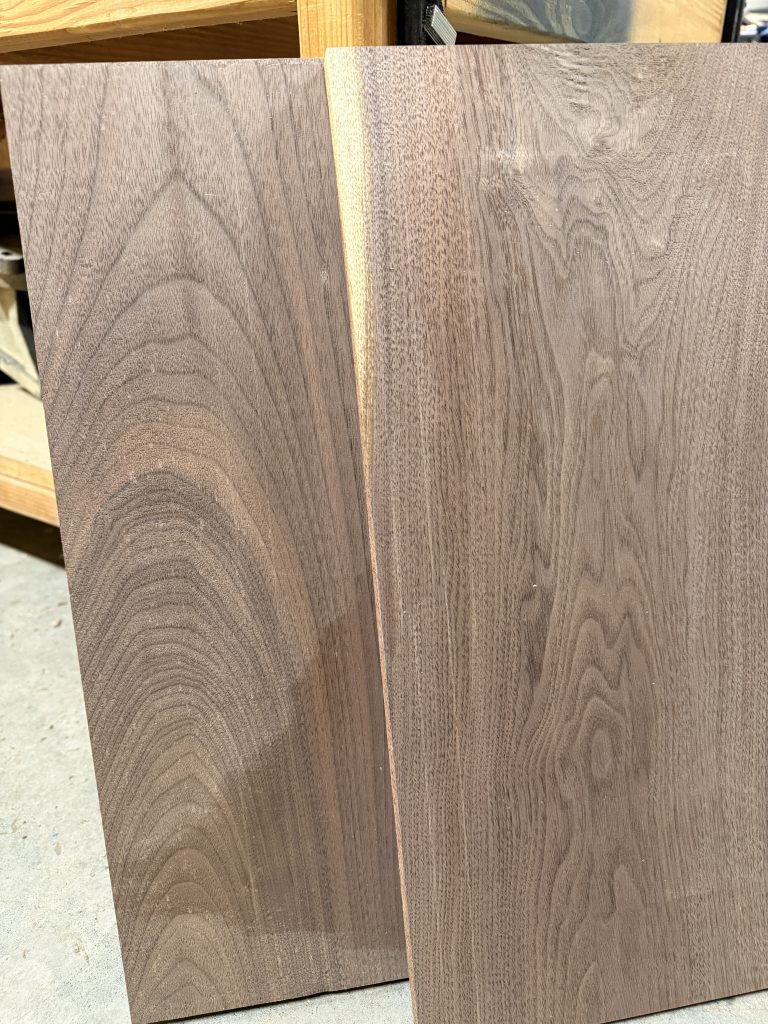
Plain-sawn lumber, also called flat sawn, is the most common cut you’ll find at a lumberyard. It’s produced by slicing the log straight through in parallel cuts. The growth rings meet the face of the board at 0º to 30º, which produces the familiar cathedral grain pattern seen in many hardwood boards. The grain arches across the face of the board in sweeping curves.
Pros
- Most affordable lumber option
- Widely available
- Most efficient use of the log
- Beautiful, dramatic grain patterns
Cons
- More prone to cupping, bowing, or twisting
- Slightly less dimensionally stable than quarter- and rift-sawn lumber
Most of the walnut used in my mudroom cabinets is plain-sawn walnut: face frames, drawer fronts, and most of the cabinet rails and stiles. Plain-sawn boards are perfectly suitable for most woodworking applications and give you the most visual character for the price.
Quarter Sawn Lumber
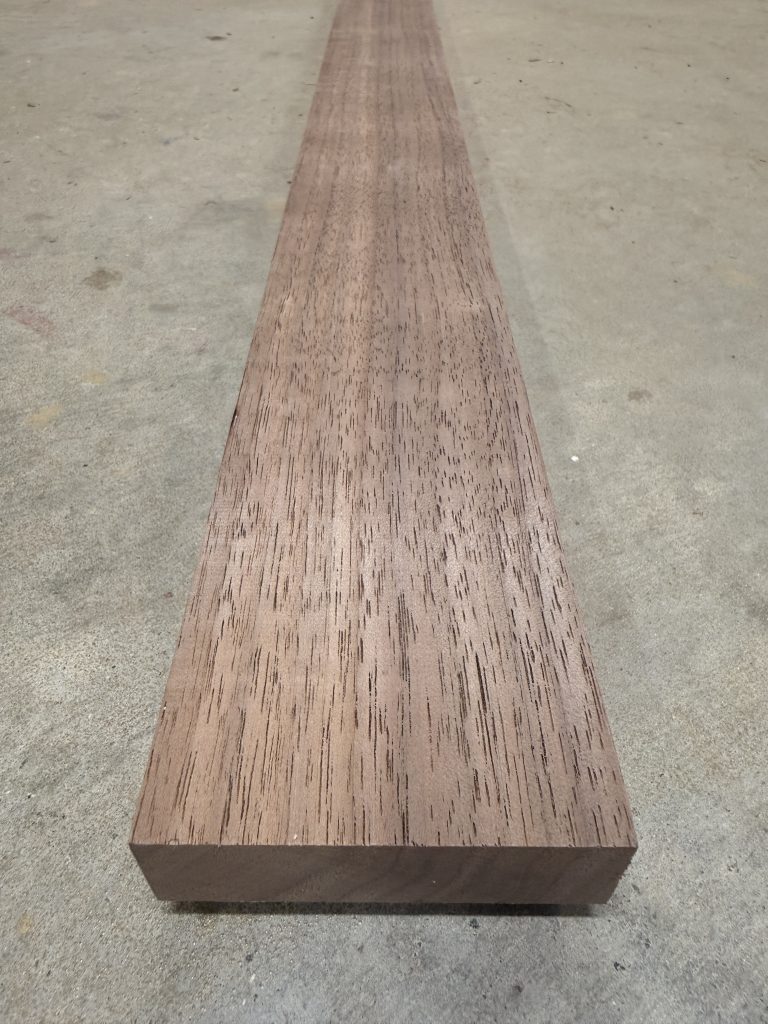
Quarter-sawn lumber is milled differently from plain-sawn lumber. Instead of slicing straight through the log, the log is first divided into quarters. Boards are then sawn so the growth rings are oriented nearly perpendicular to the board face, at about 60º to 90º. The grain pattern appears much straighter and more consistent than plain-sawn lumber. In wood species like white oak, quarter-sawn boards can also display striking ray fleck patterns.
Pros
- Significantly more stable than plain-sawn
- Less likely to cup
- More consistent seasonal movement
- Ideal for long vertical parts
Cons
- More expensive than plain-sawn
- Lower yield from each log
- Can be more challenging to source
Our mudroom lockers have doors that are about 71 inches tall. The stiles, or vertical pieces of the door frame, run the full height of the door. Long vertical boards like this are much more vulnerable to movement. If they twist or cup over time, the door can become difficult to close properly. To reduce that risk, I made a second trip to a different lumberyard to find quarter-sawn walnut specifically for those stiles.
Because quarter-sawn boards are more dimensionally stable than plain-sawn, they’re less likely to warp or distort over time. We only needed three boards, but using the right cut for that part of the project will help keep the doors straight and functioning properly for years.
Rift Sawn Lumber
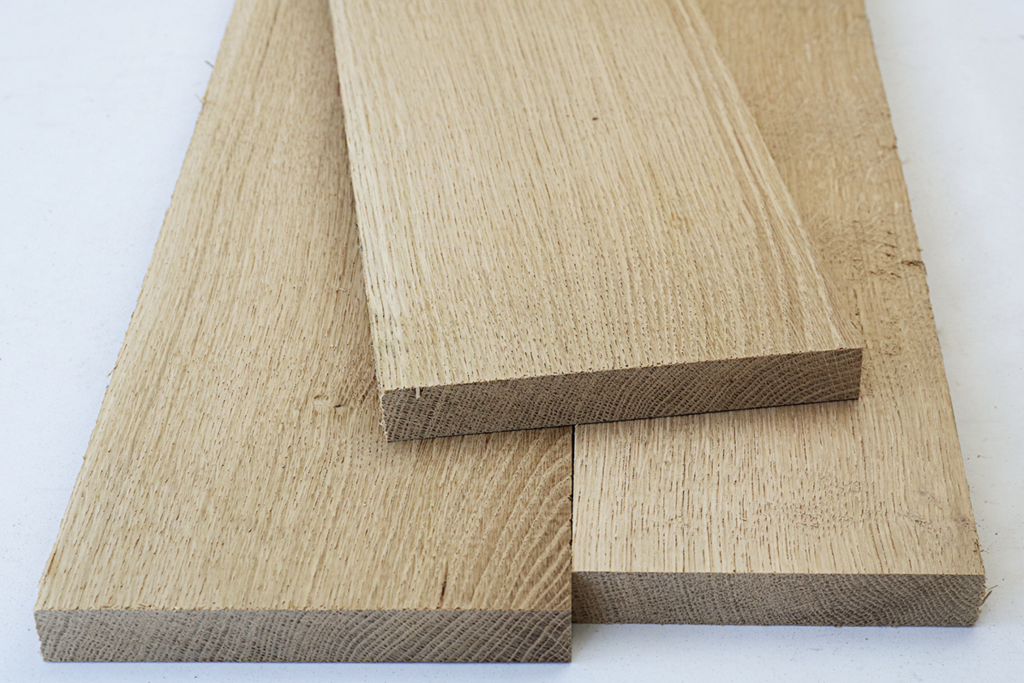
Rift-sawn lumber is another method of cutting boards from a log. In this method, boards are cut so the growth rings meet the board face at 30º to 60º. Rift-sawn boards produce an extremely straight, uniform grain pattern with minimal variation. Unlike quarter-sawn lumber, rift-sawn boards typically do not show ray fleck patterns.
Pros
- Very consistent straight grain
- Highly stable
- Clean, modern appearance
Cons
- Least efficient milling method
- Harder to find
- Typically the most expensive
Because of the lower yield from each log, rift-sawn boards are often reserved for high-end cabinetry, furniture, and modern designs where a uniform, linear grain is the star of the show.
Quick Comparison: Plain Sawn vs Quarter Sawn vs Rift Sawn
Plain-Sawn
- Grain Pattern: Cathedral/arched
- Stability: Least stable
- Prone to cupping: Yes
- Availability: Most common
- Cost: Least expensive
- Best for: General woodworking
- Ray Fleck: None
Quarter-Sawn
- Grain Pattern: Straight, with ray fleck (adds a shimmering effect)
- Stability: Highly stable
- Prone to cupping: Less
- Availability: Less common
- Cost: More expensive
- Best for: Doors and long vertical parts
- Ray Fleck: Prominent (especially in oak)
Rift-Sawn
- Grain Pattern: Very straight, uniform
- Stability: Highly stable
- Prone to Cupping: Less
- Availability: Least common
- Cost: Most expensive
- Best for: High-end, modern furniture
- Ray Fleck: Minimal/none
How To Choose the Right Lumber for Your Project
Choosing between plain-sawn, quarter-sawn, and rift-sawn lumber depends on your project’s needs, your budget, and the look you want to achieve. Here are a few tips to help you decide:
- For most general woodworking projects: Plain-sawn lumber is a great choice. It’s affordable, widely available, and offers beautiful, dramatic grain patterns. Use it for face frames, drawer fronts, and most furniture parts where slight movement won’t be a problem.
- For doors, tabletops, or long vertical parts: Consider quarter-sawn lumber. Its increased dimensional stability makes it ideal for pieces that need to stay flat and straight over time, such as tall cabinet doors, table legs, or tall stiles.
- For premium furniture or a modern aesthetic: Rift-sawn lumber is worth the investment if you want the most consistent, straight grain and maximum stability. It’s perfect for high-end furniture, especially where a clean, linear look is desired.
Pro tip: Always inspect boards for defects and select for consistent grain orientation, especially for parts where stability is critical. If you’re on a budget, plain-sawn lumber usually gives you the most value per board foot. The right lumber cut can make all the difference in how your finished project looks and lasts!
Final Thoughts
Understanding how lumber is milled from the log is a detail that can dramatically improve your woodworking results. By paying attention to grain orientation and the differences between plain-sawn, quarter-sawn, and rift-sawn lumber, you’ll make smarter choices and avoid common issues like cupping, bowing, twisting, or uneven movement.
For my mudroom lockers, going the extra mile (literally!) to find the right quarter-sawn boards means those tall doors will stay straight and stable for years to come. Have you used different lumber cuts in your own projects, or do you have tips for sourcing specialty boards? Share your experience or questions in the comments below!


wow, those walnut boards are beautiful, can’t wait to see this all come together, thanks Jeff